
Tofacitinib in Vitiligo: Case Series and Open-Label Studies ± NB-UVB
Key Takeaways Tofacitinib (JAK1/3 inhibitor) has shown facial repigmentation in multiple case series; responses improve with concurrent light (NB-UVB or […]
Key Takeaways Tofacitinib (JAK1/3 inhibitor) has shown facial repigmentation in multiple case series; responses improve with concurrent light (NB-UVB or […]
Key Takeaways TRuE-V2 confirmed facial repigmentation superiority of ruxolitinib 1.5% cream versus vehicle at ~24 weeks, mirroring TRuE-V1. Continued treatment
Key Takeaways In TRuE-V1, topical ruxolitinib 1.5% cream showed clinically meaningful facial repigmentation versus vehicle by week 24, with continued
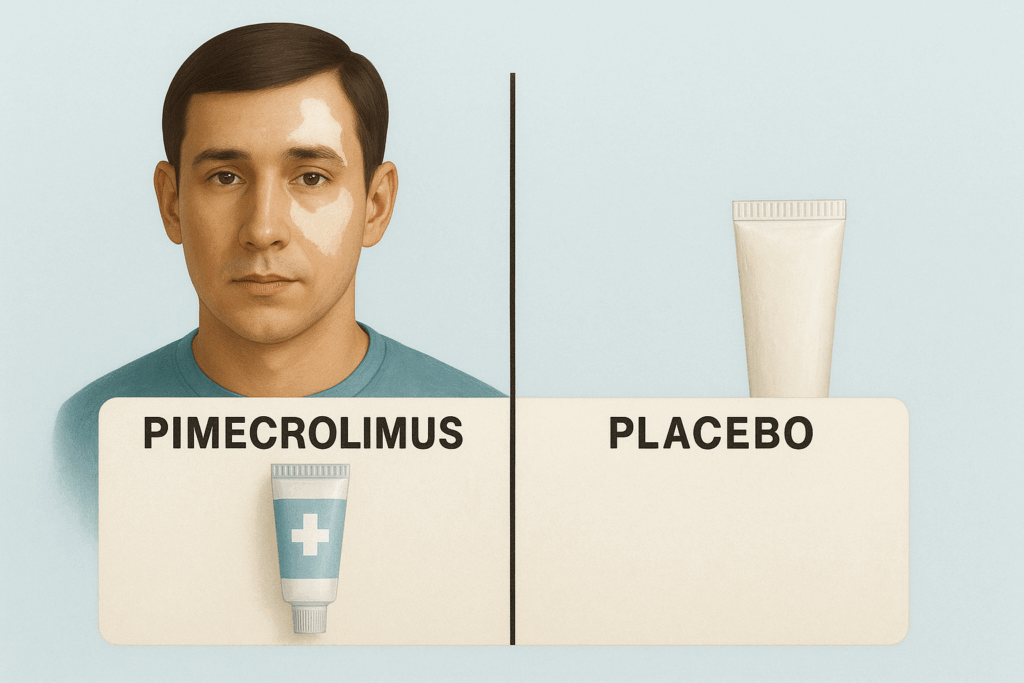
Key Takeaways For facial vitiligo, pimecrolimus 1% shows superiority over placebo on F-VASI and global assessments in several RCTs/split-face designs.
Key Takeaways Facial/neck lesions show the highest response rates to tacrolimus 0.1%, often with early perifollicular islands of repigmentation. Trunk/extremities
Key Takeaways Adding topical tacrolimus to NB-UVB is associated with higher facial response rates and earlier perifollicular repigmentation in many
Key Takeaways Excimer 308 nm is well suited for localized/focal lesions, particularly on the face and neck, enabling targeted high-fluence delivery
Key Takeaways NB-UVB achieves comparable or superior facial repigmentation versus PUVA in multiple comparative studies, with fewer systemic adverse effects.
Key Takeaways NB-UVB (311–313 nm) consistently induces clinically meaningful repigmentation across multiple cohorts; face responds best, acral sites worst. Typical regimens